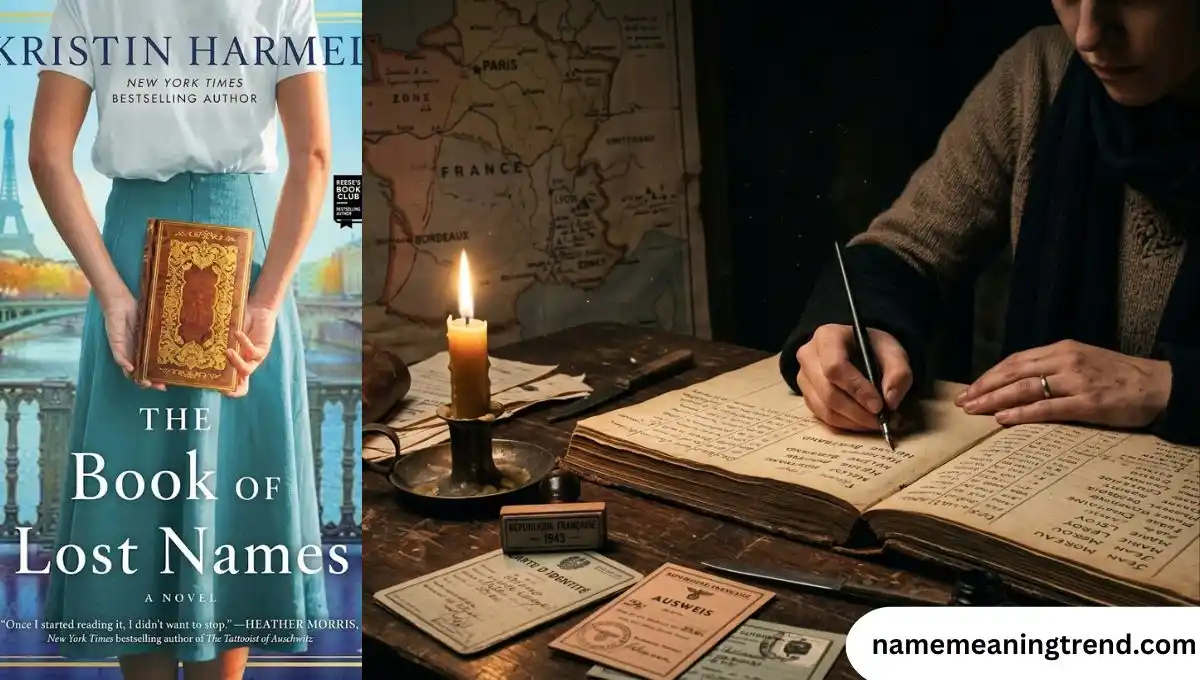
If you are looking for the WWII novel that breaks your heart, rebuilds it, and leaves you thinking for days, you are in the right place. The Book of Lost Names by Kristin Harmel is not just another war story. It is a story about identity, courage, secret codes, forbidden love, and what it means to refuse to let history erase innocent people.
This complete guide covers everything you need to know before, and after, you read the book. Whether you are a student, a book club member, a lifelong historical fiction fan, or someone who just stumbled across the title, you will find every answer here.
1. What Is The Book of Lost Names? A Complete Overview
The Book of Lost Names is a historical fiction novel set primarily during World War II in Nazi-occupied France. It was written by Kristin Harmel and first published in July 2020 by Gallery Books, an imprint of Simon & Schuster.
The novel uses a dual timeline structure, one set in 1942–1944 (wartime France) and one in 2005 (present-day Florida). This back-and-forth format keeps readers emotionally invested in both the past and the present, as they slowly uncover what happened to the story’s protagonist, Eva Traube Abrams.
Here is a quick snapshot of the book:
| Detail | Information |
| Full Title | The Book of Lost Names |
| Author | Kristin Harmel |
| Publisher | Gallery Books / Simon & Schuster |
| First Published | July 21, 2020 |
| Genre | Historical Fiction / WWII Fiction |
| Setting | Nazi-occupied France (1942–1944) and Florida, USA (2005) |
| Pages | 388 pages (hardcover) |
| ISBN (Paperback) | 978-1-9821-3190-6 |
| Goodreads Rating | 4.44 / 5 (308,000+ ratings) |
| Awards | New York Times Bestseller |
| Languages Available | 30+ languages worldwide |
At its core, the book is inspired by the true stories of real document forgers who worked with the French Resistance during World War II, risking their lives to help thousands of Jewish children escape Nazi persecution. The fictional element is Eva, but the bravery, the forgery networks, and the moral stakes were all very real.
What makes this novel stand apart from other WWII fiction is its unusual focus: not soldiers, not spies, but forgers, quiet heroes who fought back with ink, paper, and mathematical codes rather than weapons.
2. The Book of Lost Names Summary – Chapter by Chapter
Part One: Paris, 1942
The story opens in May 2005. Eva Traube Abrams, an 86-year-old semi-retired librarian in Winter Park, Florida, is working her shift when she spots a photograph in the New York Times.
The image shows an old religious book, a book she has not seen in over sixty years. She immediately recognizes it as The Book of Lost Names.
The novel then flashes back to Paris, 1942. Eva is a 23-year-old Jewish woman, the daughter of a Polish-Jewish father and a French mother.
When her father is suddenly arrested by French police cooperating with Nazi orders, Eva and her mother flee Paris. In a desperate act, Eva uses her artistic talent to forge identity papers that allow them to pass through Nazi checkpoints.
Part Two: Aurignon, Free Zone
Eva and her mother arrive in Aurignon, a small fictional village in the Free Zone of France, near the Swiss border. Though the Free Zone is technically unoccupied, it is not truly safe. The Nazis’ reach is everywhere.
In Aurignon, Eva is introduced to a network of local Resistance members led by Père Clément, the village priest. He recruits Eva to use her forgery skills to help Jewish children flee France with false identities. Eva agrees.
She soon meets Rémy Chevrolet, another young forger working with the Resistance. The two form a working partnership, and slowly, a deep romantic connection.
570+ Best Femboy Names Generator 2026: Soft, Cute, Androgynous & Aesthetic Ideas
Part Three: The Code and the Book
Eva and Rémy face a crucial problem: they are giving hundreds of children new, false names to protect them. But what happens after the war? How will these children ever reclaim their true identities?
Eva and Rémy devise a secret system. They use the Fibonacci sequence, a mathematical pattern where each number is the sum of the two before it (1, 1, 2, 3, 5, 8, 13…), as a cipher.
They record the children’s real names and their new false names inside the pages of an ancient 18th-century religious text: The Book of Lost Names. The code is hidden in plain sight, undetectable to any Nazi who might pick up the book.
Part Four: Betrayal and Loss
The Resistance network is eventually betrayed from within. Joseph, a trusted member of the group, turns informant. The network is raided. Rémy is captured and, as far as Eva can tell, killed or deported.
Eva barely escapes. Heartbroken and alone, she loses not just Rémy but her entire world in Aurignon. The Book of Lost Names is left behind when she flees.
Part Five: Present Day
Back in 2005, the older Eva boarded a flight to Berlin. She has made a decision: she will retrieve the Book of Lost Names from the German library where it is being held, and she will preserve the records of those children, now elderly adults, one last time.
She arrives at the Berlin library and meets Otto Kühn, the librarian trying to return looted Nazi-era books to their owners. Eva opens the book and confirms that her code is intact, hundreds of names, preserved through the decades.
And then, an extraordinary moment. A message arrives: an elderly man has appeared, claiming the book belongs to him.
Eva steps outside. It is Rémy. He never died. He faked his death during the war and spent decades trying to find Eva, but they kept missing each other by just years, sometimes just months.
Eva had once secretly written a marriage proposal inside the coded pages of the book, a message only Rémy would understand. Six decades later, he finally answers: “Yes.”
The novel ends with one of the most quietly beautiful lines in modern historical fiction: they begin their life together with “all the chapters still unwritten.”
3. Who Wrote The Book of Lost Names? Author Kristin Harmel Biography
Kristin Harmel is an American novelist born on May 4, 1979, just outside Boston, Massachusetts. She grew up in Ohio and St. Petersburg, Florida, and later graduated from the University of Florida with a degree in journalism and a minor in Spanish.
She began her writing career remarkably early, at just 16 years old, she was covering Major League Baseball and NHL hockey for a local sports magazine in Tampa Bay.
From there, she built a long career as a journalist, reporting primarily for People magazine and contributing to outlets including Men’s Health, Woman’s Day, and American Baby. She also regularly appeared on the national morning television program The Daily Buzz.
Today, Kristin Harmel is known worldwide as a New York Times bestselling, USA Today bestselling, and #1 international bestselling author of more than a dozen novels. Her books have been translated into more than 35 languages and are sold across the globe.
Key Books by Kristin Harmel
| Book Title | Year | Theme |
| The Sweetness of Forgetting | 2012 | Family secrets, France, WWII |
| The Room on Rue Amélie | 2018 | WWII Paris, love, resistance |
| The Winemaker’s Wife | 2019 | Champagne region, WWII secrets |
| The Book of Lost Names | 2020 | Forgery, French Resistance, identity |
| The Forest of Vanishing Stars | 2021 | Jewish survival, WWII forests |
| The Paris Daughter | 2023 | Nazi-occupied Paris, motherhood |
| The Stolen Life of Colette Marceau | 2025 | Identity theft, WWII France |
Harmel has said in interviews that most of her WWII inspiration comes from deep historical research, she did not know about the document forgers of the French Resistance until she started digging into the topic, and immediately knew it would be the basis for a novel.
She lives in Orlando, Florida, with her husband and son. She is also the co-founder and co-host of the hugely popular weekly web series and podcast Friends & Fiction, which she runs alongside four other bestselling authors.
4. The Book of Lost Names Characters – Full Character Analysis
Eva Traube Abrams, Protagonist
Eva is the heart and soul of this novel. At 23 years old in the wartime timeline, she is a young Jewish woman from Paris, quiet, artistic, and deeply principled. She never set out to be a hero. She simply refused to do nothing when her people were being erased.
Eva’s character arc is one of the novel’s greatest strengths. She transforms from a sheltered university student into a skilled forger who risks her life daily, not for glory, but because someone had to remember the children’s real names.
Her love for books and literature runs through every page, and it is no coincidence that she becomes a librarian in her later years.
Her one great flaw, or perhaps her greatest strength, is her loyalty. She waits for Rémy, protects the book for sixty years, and crosses an ocean in her eighties to make things right.
Rémy Chevrolet, Love Interest and Fellow Forger
Rémy is a young Frenchman who is already working with the Resistance when Eva arrives in Aurignon. He is warm, witty, and deeply brave, though he hides it behind a calm exterior. His partnership with Eva is the emotional engine of the wartime chapters.
What makes Rémy compelling is that his love for Eva is shown through action rather than words, through the risks he takes, the code he builds with her, and the question he finally answers sixty years too late (and yet, perfectly on time).
Mamusia (Eva’s Mother)
Eva’s mother, referred to as Mamusia throughout the novel, is one of the book’s most divisive characters. She is self-centered, often emotionally cold, and consistently critical of Eva even as her daughter risks everything to save others. Many readers find her frustrating, and intentionally so. She represents a kind of passive victim mentality that stands in sharp contrast to Eva’s active courage.
Père Clément, The Village Priest
The village priest of Aurignon is the moral backbone of the local Resistance. He is the one who first recruits Eva and gives the forgery network its spiritual legitimacy.
His quiet, steady faith in human goodness, even in wartime, is one of the novel’s most moving elements. His famous line, “The path of life is darkest when we choose to walk it alone,” echoes through the novel long after it is spoken.
Joseph, The Traitor
Joseph is a trusted member of the Resistance who ultimately betrays the entire network to the Nazis. His reveal as the traitor is one of the novel’s key plot twists. Harmel uses Joseph to pose uncomfortable questions: What drives ordinary people to collaborate with evil? Where does moral cowardice end and deliberate cruelty begin?
Otto Kühn, The German Librarian
Otto appears only in the present-day timeline as the librarian in Berlin who is working to return Nazi-looted books to their rightful owners. He serves as the catalyst that brings Eva’s past rushing back, and ultimately, the unwitting matchmaker who reunites Eva and Rémy.
Funny Jackbox Names Generator: Creative & Hilarious Ideas for Every Game (2026)
5. The Book of Lost Names Review – Is It Worth Reading?
Short answer: Yes, especially if you love WWII historical fiction.
Here is an honest, balanced review:
What Works Brilliantly
The premise is genuinely original
Most WWII novels focus on soldiers, concentration camp survivors, or resistance fighters with guns. Harmel’s decision to focus on forgers, the quiet, ink-stained heroes who made false identities, gives the story a completely fresh angle.
The details of the forgery craft (pen types, paper aging, ink matching, handwriting mimicry) are fascinating and immersive.
The dual timeline is handled with skill
The back-and-forth between 2005 and 1942 is not just a stylistic choice, it creates genuine dramatic tension. Readers know Eva survived, but how she survived, and what she lost along the way, is the question that drives every page.
The ending is unforgettable
Without giving too much away to those still reading: it is quiet, earned, and genuinely moving. Not melodramatic. Not overly sentimental. Just two people, a book full of names, and all the chapters still unwritten.
The historical research is meticulous
Harmel’s author’s note confirms she drew from real figures, including Adolfo Kaminsky, a real Jewish forger who saved an estimated 14,000 lives using false documents, and Alice Cohn, another real-life hero of the Resistance.
What Some Readers Find Lacking
Eva’s mother is exhausted
Mamusia’s constant self-pity and criticism of Eva grates on many readers, and a more complex portrayal would have made the novel even stronger.
The romance is somewhat predictable
Eva and Rémy’s relationship follows a fairly expected arc. Readers who want a truly unpredictable love story may find it slightly formulaic.
The early chapters move slowly
Several readers note that the first 50–75 pages require patience before the story fully comes alive.
Ratings at a Glance
| Platform / Critic | Rating / Verdict |
| Goodreads | ⭐ 4.44 / 5 |
| Amazon US | ⭐ 4.7 / 5 |
| Booklist | ⭐ Starred Review |
| Publishers Weekly | ✅ Positive Review |
Verdict: 4.5 / 5. This is WWII historical fiction at its most human. It does not lean on shock or brutality to make its point. Instead, it makes you feel the weight of every name that was nearly lost, and the miracle of those that were saved.
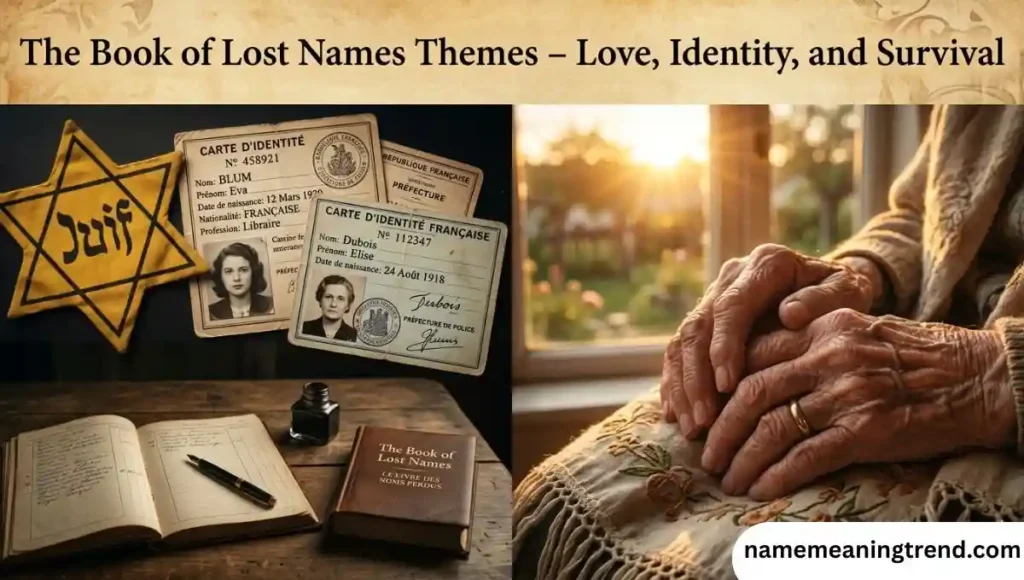
6. The Book of Lost Names Themes – Love, Identity, and Survival
This novel works on multiple levels. On the surface, it is a wartime thriller. Underneath, it is a meditation on some of the most enduring questions of human existence.
Identity and Erasure
The Nazis did not just kill people, they erased them. They stripped them of their names, their documents, their legal existence before they ever took their lives. Eva’s act of preserving real names inside a coded book is a profound act of resistance: it says, these people existed, they had names, and I will not let you erase them.
This theme resonates powerfully in 2026, when questions of identity, documentation, and the erasure of marginalized groups remain very much alive in global politics.
The Courage of Ordinary People
Eva is not a soldier. She is not trained in espionage. She is a young woman who happened to be good at drawing and chose to use that skill to fight back. Harmel’s author’s note makes this point explicitly:
“You don’t need money or weapons or a big platform to change the world.” The novel argues that ordinary courage, shown daily, quietly, without recognition, can save thousands of lives.
Love Across Time
The love story between Eva and Rémy is not just a romantic subplot. It is a story about what endures when everything else is stripped away.
The fact that their love survives 60 years of separation, missed connections, and the assumption of death, and still ends in a “yes”, is Harmel’s argument that some things cannot be erased, no matter how hard history tries.
Memory and Preservation
The book itself, the physical object at the center of the story, is a symbol of memory. In a war designed to make people forget, Eva fights back by preserving. Every name in that book is an act of defiance. Every name remembered is a small victory against genocide.
Moral Courage vs. Complicity
Through characters like Joseph (the traitor) and Eva’s mother (passive and self-focused), Harmel explores the spectrum of human behavior under impossible pressure. Not everyone becomes a hero. The novel asks, without judgment: what would you have done?
7. The Book of Lost Names Historical Background – World War II Setting
To fully appreciate the novel, it helps to understand the real historical world it depicts.
Nazi-Occupied France (1940–1944)
France fell to Nazi Germany in June 1940. The country was then divided into two zones:
- Occupied Zone: Northern France, including Paris, under direct Nazi military control.
- Free Zone (Vichy France): Southern France, technically governed by the collaborationist Vichy government under Marshal Pétain, but increasingly under Nazi influence as the war progressed.
The fictional town of Aurignon, where most of the novel takes place, sits in this Free Zone, a space that offered some protection in the early war years but grew increasingly dangerous as Nazi control extended southward after November 1942, when Germany occupied the entire country.
The French Resistance
The French Resistance was not one unified organization but a loose network of local groups who opposed the Nazi occupation through various means: sabotage, intelligence gathering, helping downed Allied pilots, and, critically for this novel, document forgery.
Forgers were among the most vital and least celebrated members of the Resistance. Without false papers, Jewish families could not travel, hide, or flee. Forged identity cards, ration books, birth certificates, and work permits were the lifelines that allowed tens of thousands of people to survive.
Real-Life Document Forgers
Two real people inspired Eva’s character:
- Adolfo Kaminsky (1925–2023): A Jewish man living in occupied France who joined the Resistance as a forger at age 17. He is estimated to have saved 14,000 lives through forged documents. His daughter Sarah wrote his biography.
- Alice Cohn (1914–2000): Another real Resistance forger who helped Jewish children escape through false documentation.
The Looting of Libraries
The novel’s present-day storyline is anchored in the real historical fact of Nazi book looting. Between 1933 and 1945, the Nazis systematically looted millions of books from Jewish families, synagogues, and institutions across Europe.
Many of these books ended up in German libraries and archives, where some remain to this day. The effort to identify and return these books to their rightful owners (or their descendants) continues in 2026.
The Fibonacci Sequence as Code
The mathematical code Eva and Rémy use to preserve the children’s names is based on the Fibonacci sequence, a series in which each number equals the sum of the two that precede it: 1, 1, 2, 3, 5, 8, 13, 21, 34, 55… This sequence has been used in cryptography and art for centuries. Its use in the novel grounds the story in real mathematical and historical practice.
IKTR Meaning in Text | What It Really Means & How to Use It Correctly
8. The Book of Lost Names Ending Explained
The ending of The Book of Lost Names is one of the most discussed and beloved aspects of the book. Here is a clear explanation of exactly what happens, and what it means.
What Happens
In 2005, elderly Eva arrives at a Berlin library to reclaim the Book of Lost Names. She finds the book intact, the Fibonacci code undisturbed, and all the children’s names still preserved inside.
As she explains the code to the librarian Otto Kühn, a receptionist interrupts: an old man has appeared outside, claiming the book belongs to him.
Eva goes outside. The man is Rémy, now in his late eighties. He did not die during the war. When the Resistance network was raided, Rémy managed to escape or was sheltered by others, but could not safely contact Eva. In the chaos and aftermath of the war, they missed each other repeatedly, sometimes by mere months.
Eva realizes something else: hidden in the coded pages of the Book of Lost Names, she had secretly written a marriage proposal to Rémy using their private cipher. It read: “Marry me. I love you.” She never thought he would find it.
He found it. His answer, sixty years later, and still somehow exactly on time, is “Yes.”
What It Means
The ending is not just a romantic resolution. It is the novel’s final argument about the power of preservation. Eva preserved the children’s names so that history could not erase them. And in the same book, she preserved something more personal, a love, a hope, a future she believed had been stolen.
The ending says: some things cannot be permanently lost. Some names, some people, some loves, survive. And when they return, even sixty years later, you begin again.
The final line, “all the chapters still unwritten,” is perfectly chosen. It does not promise a fairy tale. It promises something better: possibility.
9. The Book of Lost Names PDF – Where to Read or Download
Many readers search for a free PDF of The Book of Lost Names online. Here is honest, clear guidance:
Legal Ways to Read the Book
| Option | Platform | Cost |
| Purchase eBook | Amazon Kindle, Apple Books, Google Play Books | ~$12–15 USD |
| Purchase Paperback | Amazon, Barnes & Noble, Book Depository | ~$14–17 USD |
| Borrow for Free | Libby App (library ebook loans) | Free with library card |
| Borrow for Free | Hoopla Digital (library app) | Free with library card |
| Borrow for Free | Local public library | Free |
| Audiobook | Audible, Libro.fm | ~$15–20 USD or subscription |
| Audiobook | Libby (audio version) | Free with library card |
📌 The Libby app (by OverDrive) is the best free legal option. You simply connect your public library card, search for the title, and borrow the ebook or audiobook for free, no cost, no piracy risk. Available in the US, UK, Canada, Australia, and many other countries.
⚠️ Warning about illegal PDFs: Websites offering free PDF downloads of copyrighted books are illegal and often contain malware. They harm authors and publishers. Please use legal options, many of which are completely free through your local library.
480+ Panther Names Guide: Powerful, Creative & Meaningful Ideas with Panther Names Generator
10. The Book of Lost Names Book Club Questions and Discussion Guide
This novel is ideal for book clubs. It sparks conversation about history, morality, courage, and love.
Here are 15 thoughtful discussion questions:
- Eva learns to forge documents out of necessity, not ambition. At what point do you think she fully committed to the Resistance, and why?
- The relationship between Eva and her mother, Mamusia, is strained throughout the novel. How did you feel about Mamusia? Did you find her sympathetic, frustrating, or both?
- Père Clément says: “The path of life is darkest when we choose to walk it alone.” Where do we see this truth play out across the novel?
- Eva and Rémy’s choice to encode the children’s real names was an extraordinary act of hope. Do you think they truly believed those names would ever matter again, or was it an act of faith without certainty?
- Joseph’s betrayal is a major turning point. What do you think motivated him? How did you react when you found out who the traitor was?
- How does the dual timeline (1942 vs. 2005) affect your experience of the story? Did you find one timeline more compelling than the other?
- The Nazis used documentation as a weapon to identify and destroy Jewish communities. Eva used documentation as a weapon of resistance. What does this say about the power of bureaucracy and paperwork in ordinary life?
- Eva keeps her wartime past secret from her son for decades. Why do you think she did this? Was it the right decision?
- At the end, Eva says: “We aren’t defined by the names we carry or the religion we practice… We’re defined by who we are in our hearts.” Do you agree? Does the novel support or complicate this view?
- Rémy and Eva are reunited after 60 years. Did you find the ending realistic? Emotionally satisfying? Both or neither?
- If you had been in Eva’s position, young, scared, and untrained, do you think you would have joined the Resistance? Be honest.
- The Fibonacci sequence is used as a cipher inside an old religious book. What does it mean that the children’s names are hidden inside a text meant to preserve sacred knowledge?
- How does the theme of identity play out differently for Eva the young forger vs. Eva the elderly librarian?
- Adolfo Kaminsky, the real-life forger who inspired elements of this novel, once said he did not sleep for three days straight to produce enough documents to save Jewish children headed for deportation. How does knowing the real-history behind the novel change your experience of it?
- If you could write one name in a Book of Lost Names, someone whose memory you want to preserve, whose name would it be?
Book Club Activity Ideas
- Fibonacci code activity: Try encoding a short message using the sequence method described in the novel.
- Research a real forger: Read about Adolfo Kaminsky’s life as a companion to the novel.
- Pair with nonfiction: Adolfo Kaminsky: A Forger’s Life by Sarah Kaminsky, or A Good Place to Hide by Peter Grose (about Le Chambon-sur-Lignon, a real village that sheltered Jewish children).
11. Books Similar to The Book of Lost Names You Should Read Next
If The Book of Lost Names moved you, here are the best books to read next, curated for fans of its specific blend of WWII history, strong heroines, and emotional storytelling:
| Book | Author | Why You’ll Love It |
| The Nightingale | Kristin Hannah | Two sisters in WWII France; deeply emotional; often compared to this novel directly |
| The Alice Network | Kate Quinn | Female spies in WWI and WWII; dual timeline; fast-paced and thrilling |
| The Lost Girls of Paris | Pam Jenoff | Female spies, coded messages, dual timeline, very similar in structure |
| The Rose Code | Kate Quinn | Codebreakers at Bletchley Park; three women; WWII secrets and betrayal |
| The Huntress | Kate Quinn | Nazi war criminal hunt; female Russian pilot; gripping and original |
| Sarah’s Key | Tatiana de Rosnay | Dual timeline; Paris WWII; emotional and deeply researched |
| The Paris Library | Janet Skeslien Charles | Paris librarians resist Nazi occupation; quiet heroism; literary setting |
| The Tattooist of Auschwitz | Heather Morris | Holocaust survival; real story; devastating and beautiful |
| Lilac Girls | Martha Hall Kelly | Three women in WWII, American, German, Polish; multiple perspectives |
| The Book Thief | Markus Zusak | Books, words, and survival in WWII Germany; narrated by Death; iconic |
If you loved the French setting and dual timeline, start with The Nightingale by Kristin Hannah or Sarah’s Key by Tatiana de Rosnay.
12. The Book of Lost Names Quotes – Most Powerful Lines from the Novel
These are the lines that readers highlight, share, and remember long after they finish the book.
“You don’t need money or weapons or a big platform to change the world.”, Kristin Harmel, Author’s Note
This line, from Harmel’s own note at the end of the novel, is perhaps the most shared quote from the entire book. It is both a tribute to the real forgers of the French Resistance and a quiet challenge to the reader.
“The path of life is darkest when we choose to walk it alone.”, Père Clément
The village priest speaks this to Eva during one of her lowest moments. It is simple, pastoral wisdom, and it turns out to be completely true for every character in the novel.
“We aren’t defined by the names we carry or the religion we practice, or the nation whose flag flies over our heads. I know that now. We’re defined by who we are in our hearts, who we choose to be on this earth.”, Eva Traube Abrams
This is Eva’s most mature reflection, spoken by the older version of her, looking back. It is the novel’s clearest statement of its central argument about identity.
“Because someone should remember.”, Eva Traube Abrams
Perhaps the simplest and most devastating line in the book. This is Eva’s reason for everything, for the coded book, for the years of silence, for the journey to Berlin in her eighties. Because someone should remember.
“All the chapters are still unwritten.”, Final line of the novel
The last sentence. After everything, war, loss, sixty years of waiting, this is what remains: possibility. It is one of the most quietly beautiful final lines in recent historical fiction.
Final Thoughts
The Book of Lost Names is the kind of novel that reminds you why historical fiction matters. It does not just transport you to another era, it makes you feel it, question it, and carry a piece of it with you.
Kristin Harmel took a corner of history that most people have never heard of, the quiet, ink-stained heroism of Resistance forgers, and turned it into something luminous. Eva Traube Abrams may be fictional, but her courage, her grief, and her refusal to let history erase the innocent feel completely and utterly real.
What stays with you after you finish this book is not any single plot point. It is a feeling, the feeling that ordinary people, doing small things carefully and with love, can change the shape of history. That name matters. That memory is an act of resistance. That some loves are patient enough to wait sixty years for an answer.
And when the answer finally comes, it is worth every single year.
Frequently Asked Questions
Is The Book of Lost Names based on a true story?
Yes, it is inspired by real events. While Eva is a fictional character, the novel draws directly from the real history of Jewish document forgers in the French Resistance, including real figures like Adolfo Kaminsky, who saved an estimated 14,000 lives using forged papers.
Is The Book of Lost Names appropriate for high school students?
Yes, it is generally appropriate for readers aged 15 and up. It contains wartime violence, antisemitism, and discussion of the Holocaust, but nothing graphic. Many teachers use it as a classroom text for WWII history and literature units.
Is The Book of Lost Names part of a series?
No, it is a standalone novel. It does not connect to any other Kristin Harmel book in terms of plot or characters, though her other WWII novels share similar themes and settings.
How long does it take to read The Book of Lost Names?
At approximately 388 pages, most readers finish it in 5–8 hours. Many report reading it in a single day because it is very hard to put down once the story picks up pace.
What is the Fibonacci sequence used in the book?
Eva and Rémy hide the children’s real and false names inside an old religious book using the Fibonacci sequence as a positional cipher, meaning specific letters correspond to numbers in the sequence to disguise the coded entries as ordinary text.
What happened to Rémy in The Book of Lost Names?
Rémy was not killed during the Resistance raid as Eva believed. He faked his death or escaped and survived the war, but was unable to reach Eva in the chaos of the aftermath, leading to six decades of separation before their reunion in Berlin.
Who narrates the audiobook of The Book of Lost Names?
The audiobook is narrated by Madeleine Maby, and most listeners praise her performance as warm, emotionally precise, and perfectly suited to the story’s tone.
Where was The Book of Lost Names set?
The wartime story is set primarily in Nazi-occupied Paris and the fictional village of Aurignon in the Free Zone of southern France, near the Swiss border. The present-day timeline is set in Winter Park, Florida, and Berlin, Germany.
What awards did The Book of Lost Names win?
It debuted as a New York Times bestseller upon release in July 2020 and received starred reviews from Publishers Weekly and Booklist. It has been selected by numerous book clubs and was included in People magazine’s Best Books of Summer 2020 list.
Is The Book of Lost Names available on Netflix or as a movie?
As of April 2026, there is no confirmed film or television adaptation of The Book of Lost Names. Given its cinematic qualities and the current popularity of WWII adaptations, many fans hope an adaptation will come, but nothing has been officially announced.

Welcome to Namemeaningtrend! I’m Abdul Mannan, your AI-powered SEO wordsmith, turning humor, creativity, and 7 years of experience as a content writer into digital magic. I craft viral Names and NamesMeaning lines that make every post shine.