
The In the Black Meaning refers to a financial situation where income is higher than expenses, resulting in a profit or positive balance. This common phrase is widely used in business, accounting, personal finance, and everyday conversations about money.
You may see it in company earnings reports, financial statements, or discussions about whether a business is making money. The expression comes from traditional bookkeeping, where black ink was used to record profits, while red ink represented losses.
This is also connected to the opposite phrase, “in the red,” which means experiencing financial loss or debt. Understanding In the Black Meaning can help you quickly recognize financial language and determine whether a person, business, or organization is financially successful.
What Does “In the Black” Mean?
“In the black” is a financial idiom that describes a profitable and financially healthy position, whether it applies to a business, individual, or personal bank account. When revenue or income is higher than expenses, the finances are considered positive, meaning there is money left after costs are covered.
The phrase is the opposite of “in the red,” which refers to financial losses, debt, or a negative balance. If a company is in the black, its books show a profit rather than a loss.
This expression is commonly used in accounting, business reports, personal finance, and everyday conversations about money. Whether you’re managing a large corporation or tracking freelance earnings, being in the black simply means your finances are moving in a positive direction.
AC/DC Cultural Reference
The phrase even crossed into pop culture. AC/DC released their iconic album “Back in Black” in 1980, one of the best-selling rock albums in history, borrowing the financial idiom to signal a powerful comeback after the death of lead singer Bon Scott. Finance gave the phrase its meaning. Rock music made it immortal.
The Origin and History of the Idiom “In the Black”

This phrase has a surprisingly literal beginning. Both “in the black” and “in the red” originated from the record-keeping practices of business, where financial losses were written in red and financial profits were written in black. “In the black” originated in the first half of the 1900s.
Before spreadsheets existed, accountants sat with physical ledgers and two colors of ink. To differentiate between debit and credit, accountants started using black and red colored ink.
Red is a harsh color that attracts immediate attention, so it was used to denote debts and losses, generating an idea of something bad or negative.
The evolution of technology has since transformed accounting practices, but the language stuck. Even modern accounting software still highlights negative figures in red. The visual logic remains the same, just on screens instead of paper.
Accounting Software Context
In fact, this color logic is still actively built into today’s most popular accounting tools. QuickBooks, Xero, and FreshBooks all display negative balances and losses in red and profitable figures in black or green. The terminology changed from ink to pixels, but the meaning never moved an inch.
What Does “Back in the Black” Mean?
“Back in the black meaning” returning to profitability after a period of losses. The word back signals a turnaround, things were bad, action was taken, and finances recovered. It means you are no longer losing money and are now profitable again.
Collins Dictionary captures it perfectly: “Last year, the company was back in the black, showing a modest pre-tax surplus of £4.6 million.”It is a phrase of relief and recovery, more powerful than simply saying “in the black” because it implies the struggle that came before.
Apple Turnaround Example
The most powerful real-world example is Apple. In 1997, Apple lost $1.04 billion in a single year, the company was weeks away from bankruptcy. Steve Jobs returned as interim CEO, cut 70% of Apple’s product line, and refocused the entire business.
By 1998, Apple had swung to a $309 million profit. That is what “back in the black” looks like in real life, not just a phrase but a complete financial resurrection.
In the Black vs In the Red: What’s the Difference?
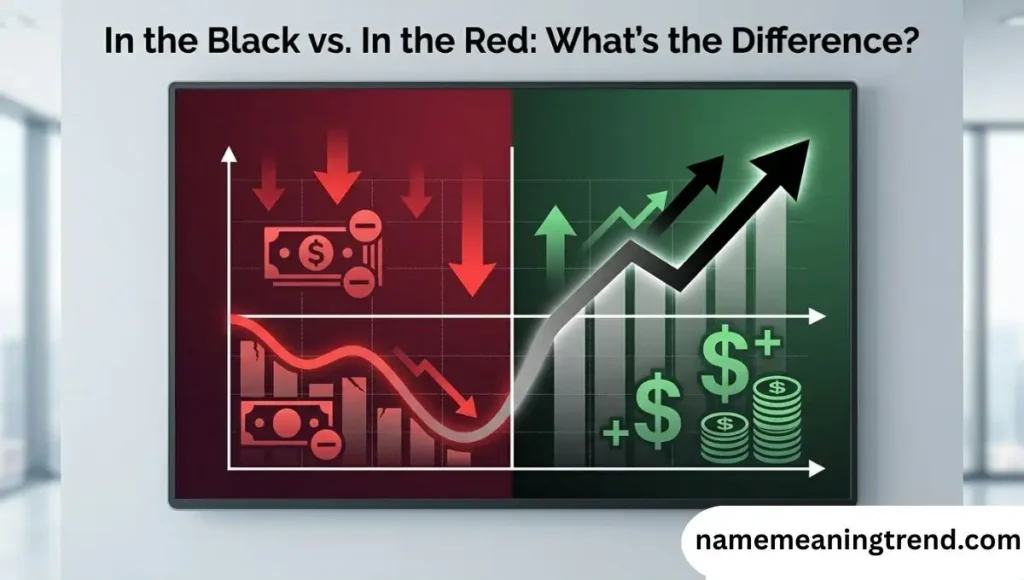
These two idioms are opposites, and they’re almost always discussed together.
| Feature | In the Black | In the Red |
| Financial Status | Profitable / Positive balance | Loss-making / Negative balance |
| Cash Flow | Revenue exceeds expenses | Expenses exceed revenue |
| Debt | Little to none | In debt or deficit |
| Business Signal | Healthy, solvent | At risk, struggling |
| Ink Color Origin | Black ink = profits | Red ink = losses |
Being “in the black” indicates financial health and profitability, while “in the red” signifies that a business or individual is operating at a loss or has a negative financial balance, meaning expenses exceed revenues, resulting in a deficit.
One important nuance: a new company investing heavily in research and development during its first few years may be in the red, but eventually it pays off, being in the red initially can lead to being in the black eventually. Context always matters.
What Does “In the Red” Mean?
“In the red” means being in debt or operating at a financial loss. It comes from the old accounting practice of recording losses in red ink. When a business or person is in the red, expenses exceed income, the balance tips in the wrong direction.
It doesn’t matter if it’s a small dip or a big one, it still means more is going out than coming in. For individuals, it means an overdrawn bank account. For businesses, prolonged time in the red without a recovery plan often leads to bankruptcy.
What Does “In the Black” Mean in Business and Finance?

In a corporate context, being in the black goes beyond just profit. It signals overall financial solvency and operational strength.
At its core, when a company is in the black, it has achieved profitability. This suggests that the company is financially solvent, bearing a manageable debt load, and is equipped to continue its operations without the looming threat of bankruptcy.
Accounting Software Context
It is worth understanding exactly where “in the black” begins, it starts the moment a business crosses its break-even point. Break-even is where total revenue equals total costs, meaning zero profit and zero loss.
The instant revenue pushes past that line and generates surplus, the business moves into the black. That crossing point is one of the most-watched milestones in any business.
Industries With Thin Margins
Not every industry finds it equally easy to stay in the black. Restaurants operate on net profit margins of just 3–9%. Airlines regularly swing between profit and loss based on fuel prices alone.
Retail businesses face constant pressure from inventory costs and falling consumer demand. For these industries, being in the black is not a given, it is a daily operational achievement.
Net Profit Margin
The depth of being “in the black” is measured by net profit margin, the percentage of revenue that remains as actual profit after all expenses are paid. A business with a 20% net profit margin is far more securely in the black than one running at 2%. The higher the margin, the stronger and more stable the position.
It also opens doors. Companies in the black often find it more straightforward to secure funds for business needs, whether through equity financing or debt financing. Investors feel confident. Credit lines open up. Growth becomes easier to pursue.
For shareholders specifically, this matters a lot. A company’s profitability reinforces stakeholder confidence, shareholders derive assurance from such financial health, anticipating dividends and continued growth.
610+ Good Feet Finder Names: A Compelling List for Every Style
“In the Black” Examples Used in a Sentence
Here are natural, real-world examples of how the phrase is used:
In business news: “Asian shares ended the first week of the year in the black, in contrast to last year when a crash in Chinese stocks rattled global markets.” Wall Street Journal
In everyday dialogue:
“After three tough quarters, the company finally finished the year in the black.”
“She managed her freelance income so well that by March she was already in the black.”
“The startup burned through cash early, but aggressive cuts got them back in the black by Q3.”
Stock Market Reporting
In stock market reporting: “European markets ended the session in the black on Wednesday, with the FTSE 100 gaining 0.8% and the DAX closing up 1.1% amid cooling inflation data.”
Financial media use this phrase daily when indexes close with gains. Whenever you hear “markets ended in the black,” it means major indexes finished the trading day with a net positive close.
In government/policy: “The town of Gene Autry approved its $42,000 budget in a unanimous council vote, ending the fiscal year and beginning the next in the black.”, The Daily Ardmoreite
These examples show how naturally the phrase fits into both financial reporting and everyday speech.
Synonyms and Related Expressions for “In the Black”
When you want to avoid repetition or simply need alternatives, these expressions carry the same meaning:
- Turning a profit, actively generating more income than expenses
- Financially solvent, able to meet all debt obligations
- In the green, a less common but used variant
- Breaking even or better, at minimum covering all costs
- Out of the red, transitioned from loss to profit
- Cash flow positive, more cash coming in than going out
- Profitable, the straightforward single-word version
All of these describe a state where your financial position is stable or growing. Being “in the black meaning” is fundamentally a sign of financial health and profitability, whichever synonym you use, that core meaning stays intact.
Why Is It Called “Black Friday”? The “In the Black” Connection
Most people assume Black Friday got its name from chaotic crowds or dark retail energy. The actual origin is far more interesting.
Retail businesses frequently run their businesses “in the red,” buying inventory ahead of its sale. On the day after Thanksgiving, Black Friday, retailers have traditionally been able to move sufficient inventory to bring their accounting ledgers above the zero line and into black ink.
In other words, Black Friday was the single day each year when many retailers finally crossed into profitability. Their books went from red to black, literally. The name reflects that accounting milestone, not the shopping chaos.
This connection makes “in the black” and “Black Friday” two sides of the same historical coin. One describes a state; the other marks the moment retailers historically achieved it.
Meaning of Song Soft Love The Symposium 2026: Is There a Hidden Love Message for You?
What Does “In the Black meaning” for Personal Finances?
The idiom doesn’t belong exclusively to corporations, it applies just as meaningfully to individuals managing their own money.
For a personal bank account, being in the black simply means your balance is positive. You have more money than you owe. If a bank account is in the black, it contains some money. That’s the baseline.
IKTR Meaning in Text | What It Really Means & How to Use It Correctly
For individuals, staying in the black meaning requires tracking income versus expenses, building an emergency fund, avoiding lifestyle inflation, and clearing high-cost debt first. It’s not about being rich. It’s about financial balance, spending less than you earn.
Key Takeaways
- “In the black” means profitable, solvent, or having a positive financial balance.
- It originated from black ink used in physical accounting ledgers in the early 1900s to record profits.
- The direct opposite is “in the red,” meaning loss, debt, or negative balance.
- In business, it signals healthy cash flow, low debt risk, and investor confidence.
- Black Friday is directly named after this idiom, the day retailers traditionally moved into profitability.
- For individuals, it means spending less than you earn and maintaining a positive account balance.
Frequently Asked Questions
What Does “In the Red” Mean?
“In the red” means operating at a financial loss or carrying more debt than income. It is the direct opposite of “in the black” and signals negative cash flow or deficit.
What Does “In the Black Meaning” Mean in Slang?
In casual, everyday slang, “in the black” simply means doing well financially, you’re not broke, not in debt, and comfortably ahead of your expenses.
What Does “In the Black Meaning” Mean in Military Context?
In military usage, “in the black” means performing within acceptable or target parameters, a unit, mission, or resource is operating correctly and on track without critical issues.
What Does “In the Black Meaning and In the Red” Mean Together?
Used together, these two phrases describe opposite ends of financial health, “in the black” means profit and solvency, while “in the red” means loss, debt, or a negative balance.
What Is an “In the Black” Idiom Sentence?
A common example: “After two difficult years, the restaurant finally finished the quarter in the black.” It means the business turned a profit during that period.
What Does “In the Green” Mean?
“In the green” carries essentially the same meaning as “in the black”, financially positive, profitable, or performing well. It is less common but used in similar contexts.
What Does “In the Black Meaning” Mean for a License Plate?
A black license plate typically refers to a vintage, special edition, or legacy plate design issued by certain U.S. states, it carries no direct financial meaning and is unrelated to the financial idiom.
Conclusion
The In the Black Meaning has its roots in traditional bookkeeping, but the phrase is now widely used in business, accounting, news, and everyday financial conversations. It consistently represents profitability, financial stability, and a positive balance.
Whether you manage a business, freelance income, or a personal budget, staying “in the black” is a sign of healthy finances. Understanding its origin and meaning helps you use this financial idiom correctly and recognize it when reading reports or discussing money.

Welcome to Namemeaningtrend! I’m Abdul Mannan, your AI-powered SEO wordsmith, turning humor, creativity, and 7 years of experience as a content writer into digital magic. I craft viral Names and NamesMeaning lines that make every post shine.