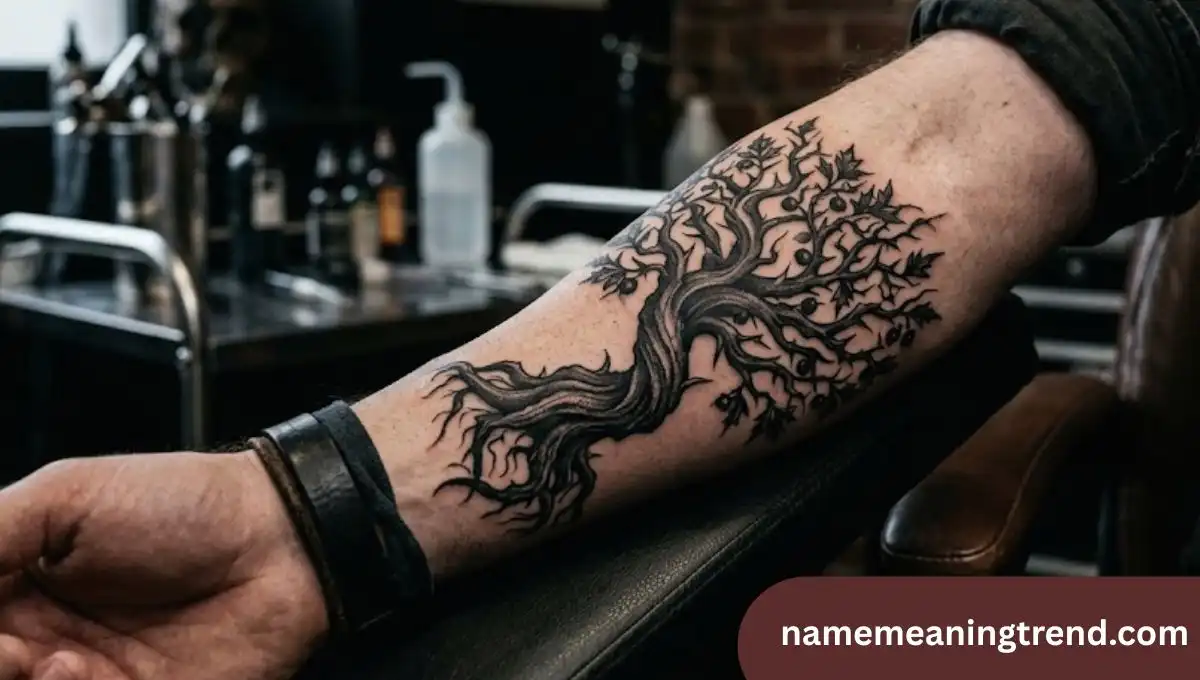
A Poison Tree tattoo is one of the most powerful and emotionally deep tattoo choices in 2026. More and more people are choosing this design because it carries a strong message, it represents hidden anger, silent pain, and the dangerous side of keeping your feelings bottled up inside.
Inspired by William Blake’s famous poem “A Poison Tree,” this tattoo has grown in popularity across social media platforms like Instagram and Pinterest, where dark and meaningful tattoo art is trending big this year. The beauty of a Poison Tree tattoo is that it means something different to everyone who wears it. For some, it is a reminder to express emotions before they turn toxic.
For others, it is a symbol of personal growth, survival, or even a warning to fake friends. Whether you want a small minimalist design or a detailed dark art sleeve, this guide will walk you through every meaning, style, and placement option so you can make the perfect choice for your next tattoo in 2026.
What Does a Poison Tree Tattoo Mean?
Core meaning behind a poison tree tattoo
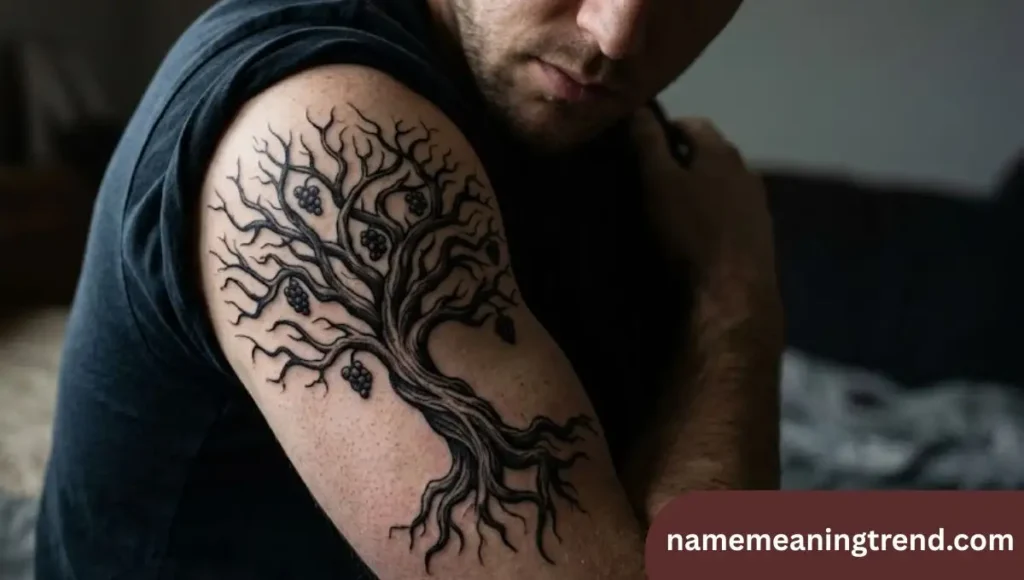
The core meaning of a poison tree tattoo is usually suppressed emotion. Most often, that emotion is anger, but it can also be grief, betrayal, jealousy, regret, or resentment. The tree becomes a visual metaphor for a feeling that was never properly released and kept growing below the surface.
Why this tattoo feels dark, emotional, and powerful
It feels dark because it is not about surface beauty. It is about what happens when pain is fed in private. The design often carries a heavy emotional tone because trees normally symbolize life, healing, and growth, but here that same growth becomes toxic. That reversal is what gives the symbol its punch.
Here is what most people miss: the design is powerful not only because it represents pain, but because it shows pain with time added to it. A wound can hurt once. A poison tree suggests that the wound was nurtured, revisited, and emotionally cultivated until it changed the person carrying it.
Common symbolism people associate with it
Common meanings include hidden anger, betrayal, revenge, emotional poisoning, toxic relationships, deception, inner darkness, and personal transformation. In modern tattoo use, it can also mean “I survived what tried to poison me.”
The Symbolism Behind a Poison Tree Tattoo
Anger and hidden resentment
This is the most direct symbolism. Blake’s poem openly contrasts two outcomes: anger expressed to a friend ends, but anger hidden from an enemy grows. That idea shaped the modern symbolic reading of the tattoo.
If you want the simplest meaning, a poison tree tattoo often means anger that was never spoken.
Betrayal and emotional pain
Many people choose this tattoo after betrayal because betrayal rarely feels loud at first. It often sits quietly, then keeps spreading. The poison tree captures that emotional timeline better than many other dark tattoos because it suggests a pain that deepened gradually.
Revenge and silent bitterness
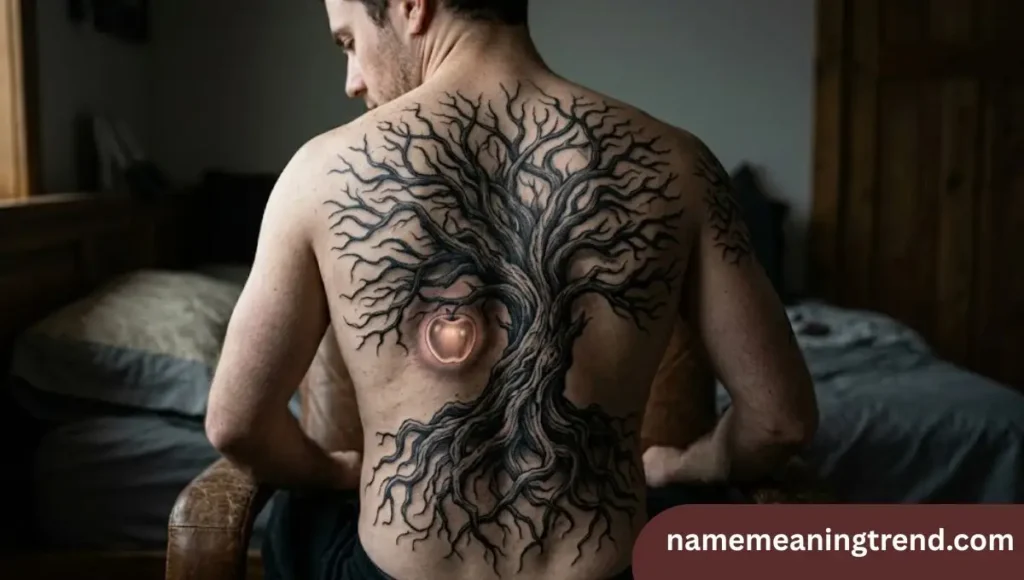
The tattoo can also symbolize revenge, especially when the tree includes fruit, a skull, thorns, or a snake. The “bright apple” in Blake’s poem is especially important because it suggests temptation. Revenge is not only destructive; it is seductive. That detail is one of the smartest symbolic layers in the entire design.
Growth of negative emotions
This is where the tree metaphor becomes brilliant. Trees do not appear overnight. They grow through repetition, time, and nourishment. In the poem, anger is “watered” with fears and tears and “sunned” with smiles and deceit. That means the speaker is not just feeling anger. He is unintentionally or deliberately feeding it.
Inner darkness and personal struggles
For some wearers, the tattoo is less about another person and more about the self. It can represent depression, unresolved trauma, guilt, shame, or a phase of life where inner thoughts become corrosive.
Here is what most people miss: the poison tree can symbolize self-poisoning, not just hurting others. That makes it psychologically stronger than a simple revenge tattoo.
IKTR Meaning in Text | What It Really Means & How to Use It Correctly
Poison Tree Tattoo Meaning in Literature
Connection to William Blake’s A Poison Tree
The literary root of this tattoo is William Blake’s poem A Poison Tree, published in 1794 in Songs of Experience. The poem is one of the clearest literary warnings about suppressed anger and the damage it can create.
How the poem influences tattoo symbolism
The tattoo borrows several core images from the poem: the growing tree, the bright apple, the hidden garden, false smiles, and the final destructive outcome. Because the poem uses an extended metaphor, it translates naturally into tattoo art. That is a big reason this design resonates with literary tattoo lovers.
Literary meaning: hidden anger becomes destructive.
Tattoo meaning: what you bury emotionally may eventually define you.
Literary meaning vs personal meaning
Literary meaning is fairly stable: hidden wrath grows. Personal meaning is more flexible. One person may wear it as a reminder not to bottle things up. Another may wear it as a mark of betrayal. Someone else may use it to show they moved through darkness and came out wiser.
Spiritual Meaning of a Poison Tree Tattoo
Warning against toxic emotions
Spiritually, the poison tree can represent the danger of feeding hatred, envy, or bitterness. Many modern interpretations read it as a warning that destructive emotions do not stay contained. They spread into thoughts, choices, and relationships. Lessons about forgiveness and healing
A more balanced spiritual reading sees the tattoo as a reminder to release what is poisoning the heart. In that sense, it is not celebrating darkness. It is exposing it. That distinction matters.
Spiritual transformation through pain
Some people reinterpret the poison tree not as the end of the story, but as the beginning of awareness. The pain is real. The poison is real. But naming it breaks its power.
Here is the less obvious insight: spiritually, this tattoo can work as a confession symbol. Not “look how dark I am,” but “I know what bitterness can do, and I refuse to stay asleep to it.”
Read Also: 570+ Best Femboy Names Generator 2026: Soft, Cute, Androgynous & Aesthetic Ideas
Psychological Meaning of a Poison Tree Tattoo
Repressed anger and emotional buildup
In psychology, suppressed anger is one of the most well-documented sources of long-term mental health struggles. It doesn’t disappear when swallowed, it converts. Into depression, into physical pain, into chronic anxiety.
The poison tree tattoo is remarkably accurate as a psychological metaphor. The roots are the buried feelings. The trunk is the identity built around suppression. The fruit is the eventual consequence: emotional eruption, illness, or the quiet destruction of relationships.
Symbol of trauma, regret, or unresolved conflict
Not every poison tree tattoo is about revenge. Sometimes it marks a conflict that was never resolved, a betrayal that was never explained, or trauma that kept growing quietly in the background. That is why the tattoo often appeals to people who have complicated emotional histories.
A reminder of emotional self-awareness
For many wearers, the tattoo functions almost like a private warning label: speak sooner, process faster, do not let silence turn pain into identity.
But that is not the full story. The reason this symbol works so well psychologically is that it shows process, not just emotion. It captures how feelings become patterns.
Poison Tree Tattoo Meaning for Men
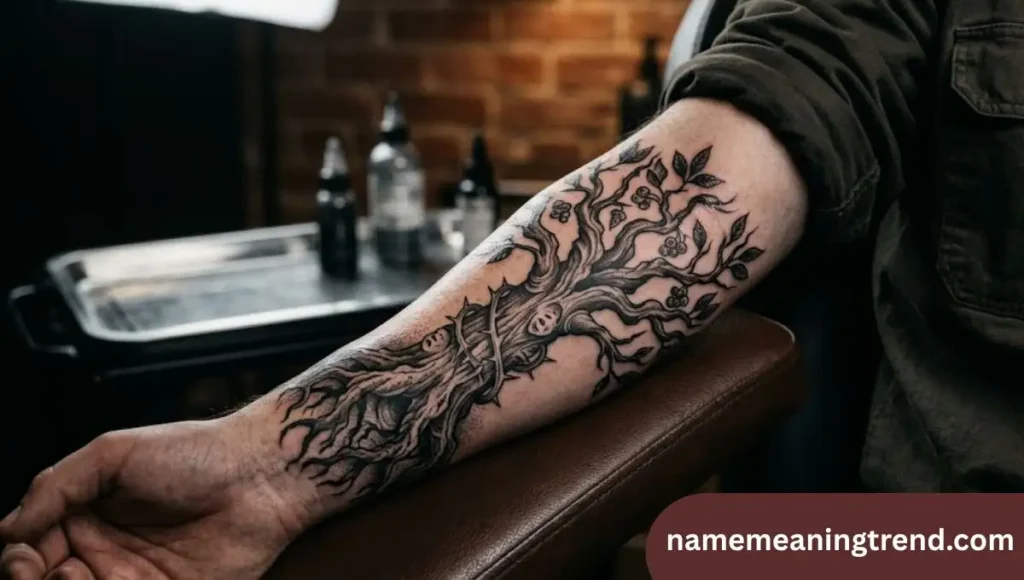
Strength, Pain, and Emotional Control
Men are disproportionately socialized to suppress emotional expression. The poison tree speaks directly to that experience: the anger that has nowhere to go, the pain that gets filed under “fine,” and the grief that converts into silence.
For men, this tattoo often carries a message of quiet endurance: “I felt more than I ever showed. And it changed me.”
Masculine Interpretations of Dark Symbolism
Many men choose bold, high-contrast blackwork designs, deep roots, dramatic branches, and a single prominent fruit. The visual weight matches the emotional weight. The tattoo doesn’t perform vulnerability. It contains it.
Some men pair the tree with a skull, representing mortality and consequence. Others add a serpent, invoking temptation and the kind of knowledge that only comes through pain.
Why Men Choose This Design
Based on available accounts from tattoo communities as of 2026, men frequently cite three specific reasons: honoring a period of profound personal struggle, marking recovery from betrayal or a toxic relationship, or connecting with Blake’s poem as a piece of emotional truth they had never found expressed anywhere else.
Funny Jackbox Names Generator: Creative & Hilarious Ideas for Every Game (2026)
Poison Tree Tattoo Meaning for Women
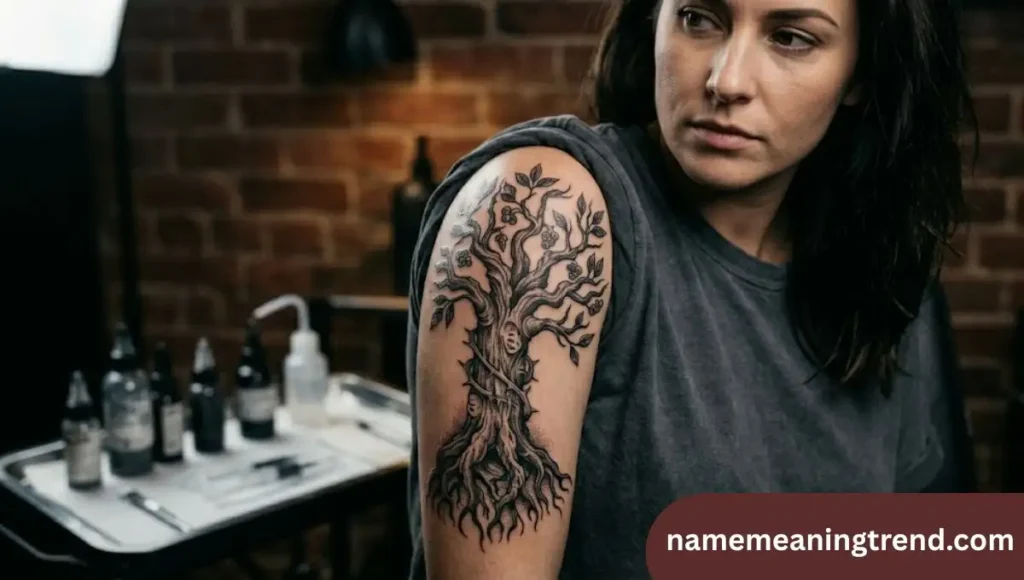
Emotional Depth and Hidden Strength
Women who wear this tattoo often describe it as an act of reclaiming the narrative of their own pain. Not displaying weakness, displaying the full depth of their emotional experience and their refusal to minimize it.
For many women, the poison tree represents the full complexity of what they carry: love and resentment, grief and strength, gentleness and fury, existing simultaneously without contradiction.
Symbol of Survival After Betrayal
Betrayal, whether by a partner, a family member, or a trusted friend, is one of the most cited motivations for this tattoo among women. The tree marks the fact that they survived it. Not unscathed. Not unchanged. But still standing, still growing, still rooted.
Feminine Interpretations of the Design
Women often choose more intricate designs, detailed root systems, delicate leaves, watercolor elements, or flowers growing alongside the poisonous branches. These choices frequently represent duality: the capacity to nurture beauty even from poisoned soil.
Placement tends toward the ribcage, thigh, or shoulder blade, locations that feel personal and intentional rather than purely visible.
Popular Poison Tree Tattoo Designs and Their Meanings
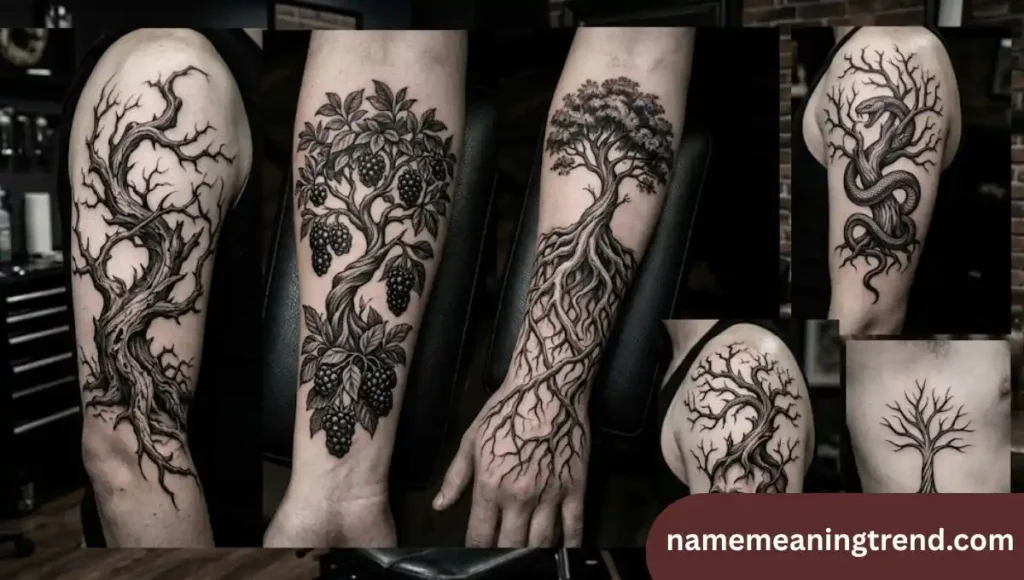
Dead Poison Tree Tattoo Meaning
A completely bare, leafless tree with no fruit symbolizes the aftermath of emotional depletion, when anger or grief has run its course and left only the skeletal structure behind. It speaks to endings, exhaustion, and the quiet that follows long emotional storms. Some interpret this as peace. Others as loss.
Poison Tree With Fruit Tattoo Meaning
The fruit, almost always a dark apple, is the most charged element in the entire design. It represents the consequence of suppressed emotion made real and visible. The fruit is what the anger eventually becomes. If it glows, it’s tempting. If it’s rotten, it’s a warning. The choice belongs entirely to the wearer.
Poison Tree With Roots Tattoo Meaning
Emphasis on the root system represents the deep, hidden work of suppression, the emotional labor that happens entirely underground, invisible to everyone else.
Roots spreading wide can also suggest strength: deeply anchored despite the toxicity above. Many wearers who choose prominent roots are marking survival of a long, slow, invisible struggle.
Poison Tree and Snake Tattoo Meaning
The serpent coiled around the trunk is one of the most powerful combinations. It evokes the Garden of Eden, temptation, forbidden knowledge, and the cycle of destruction and rebirth. The snake also represents transformation, it sheds its skin. Together, tree and snake suggest that even toxic experiences carry wisdom and that transformation often requires confronting exactly what you fear most.
Poison Tree With Skull Tattoo Meaning
Adding a skull, integrated into the roots, perched among branches, or resting beneath the fruit, emphasizes mortality and consequence. This is a memento mori variation: a reminder that every emotional decision carries a cost, and that time, like the poison tree, doesn’t stop growing.
Minimalist Poison Tree Tattoo Meaning
A clean single-line or simple silhouette design carries everything the complex version does, with the power of restraint. Sometimes simplicity is itself the statement: “I know what this means. I don’t need to explain it to anyone.” Minimalist versions age exceptionally well and work beautifully on wrists, inner arms, and behind the ear.
PTSO Meaning Slang | What PTSO Really Means in Text, TikTok & Social Media
Poison Tree Tattoo Placement Meaning
| Placement | What It Communicates | Best Design Style |
| Upper Arm | Strength carried daily; controlled visibility, you decide when it’s seen | Medium detail, slight wrap |
| Forearm | Openness, you are no longer hiding your story. Bold public statement | Vertical flow, roots to canopy |
| Chest | Close to the heart. Deep emotional meaning kept in the most private place | Spread design or centered trunk |
| Back | Burdens carried in silence, shaping your backbone. Power you don’t display | Large, dramatic, full spine or shoulder blade |
| Leg / Thigh | Weight from the past you carry forward; grounded, private, deeply rooted | Large detailed designs with room for roots and canopy |
Arm placement
The arm often suggests visible strength and personal expression. It is a good placement for someone who wants the symbolism to be seen and discussed.
Forearm placement
Forearm placement is often associated with confidence and toughness, while also staying highly visible in daily life. That makes it a strong choice for a tattoo meant to function as a constant reminder.
Chest placement
The chest usually feels more intimate. Placement guides commonly connect chest tattoos with love, personal importance, and emotional closeness, which makes this a strong option for betrayal or heart-centered pain symbolism.
Back placement
The back suits larger, story-heavy designs. It can symbolize what you carry behind you, what shaped you, or what remains unseen by most people.
Leg or thigh placement
Thigh tattoos often feel more private and sentimental. Placement symbolism often connects the thigh with personal value and selective visibility.
Best placement for meaning: forearm for daily reminders, chest for emotional weight, back for full symbolic storytelling.
Read More: Lumon Meaning Explained: Origins, Usage, and Modern Interpretations Simplified!
Is a Poison Tree Tattoo a Positive or Negative Symbol?
Dark meaning vs personal empowerment
It can be either. On the surface, it is a dark symbol. But personal tattoos are not judged only by imagery. They are judged by intention.
When it represents pain
It represents pain when the wearer connects it to betrayal, rage, unresolved grief, or emotional toxicity that still feels active.
When it represents healing and growth
It represents healing when the wearer sees it as a lesson: do not let silence feed poison. In that sense, the tattoo becomes wisdom, not just a wound.
Who Should Get a Poison Tree Tattoo?
Dark Meaning vs Personal Empowerment
This is the question people ask most, and the honest answer is: both, depending entirely on the wearer’s intention.
The symbol itself is neutral. What activates meaning is the story the wearer brings to it. A poison tree worn by someone celebrating their survival is an empowerment symbol. The same image worn by someone still inside the pain is a marker of that pain. Neither interpretation is wrong.
When It Represents Pain
Some people get this tattoo in the middle of their darkest chapter, not as a celebration, but as acknowledgment. “This is where I am right now. This is real.” The tattoo becomes a witness to their experience when no one else sees it clearly.
When It Represents Healing and Growth
Many wearers describe their poison tree tattoo as a marker of transformation, the moment they chose to stop letting pain define them silently, and instead claimed it publicly. In this context, the tattoo is deeply positive. The poison didn’t kill the tree. It made it grow.
Things to Consider Before Getting a Poison Tree Tattoo
People Drawn to Literary Tattoos
If you connect deeply with poetry, literature, or the written exploration of emotion, this tattoo provides an anchor to one of the most psychologically astute poems in the English language. It’s a design that will still carry meaning forty years from now.
Those Expressing Anger, Betrayal, or Healing
If you’ve experienced something that left a permanent mark, a betrayal, a loss, a long period of silent struggle, this tattoo gives that experience a visible form. It doesn’t require explanation. It simply exists as proof that you carried something significant.
Wearers Who Like Dark Symbolic Art
Even purely aesthetically, the poison tree is a stunning design. Gothic, dramatic, rich with visual texture, it’s a tattoo that rewards long looking. People drawn to dark art, mythology, or complex symbolism will find this design endlessly compelling.
Final Thoughts on Poison Tree Tattoo Meaning
A poison tree tattoo is one of those rare designs that works on multiple levels at once. It can symbolize anger, betrayal, revenge, secrecy, trauma, and inner darkness, but it can also represent awareness, survival, and the choice to stop feeding what harms you.
That is why it keeps showing up in search and in tattoo culture. It is not just visually dark. It is emotionally intelligent. And when done well, it does more than look striking. It tells the truth about what silence can grow into.
Frequently Asked Questions
What does a poison tree tattoo mean?
It usually means hidden anger, betrayal, resentment, revenge, or emotional pain that grew over time.
Is a poison tree tattoo always negative?
No. Many people use it as a healing symbol and a reminder to face emotions honestly.
Is this tattoo connected to William Blake?
Yes. Its strongest literary meaning comes from Blake’s 1794 poem A Poison Tree.
What does the fruit mean in a poison tree tattoo?
The fruit often symbolizes temptation, revenge, or the visible result of hidden bitterness.
What does a dead poison tree tattoo mean?
It usually represents the end of a toxic phase, emotional closure, or pain that no longer has power.
Which placement works best for this tattoo?
Forearms, chest, and back are the most meaningful because they balance visibility, emotion, and design space.
Why do people choose this tattoo?
People choose it for literary symbolism, betrayal stories, emotional depth, or as a warning against suppressed anger.
Is a poison tree tattoo good for men and women?
Yes. The symbolism is universal, though men and women may style the design differently.

Welcome to Namemeaningtrend! I’m Abdul Mannan, your AI-powered SEO wordsmith, turning humor, creativity, and 7 years of experience as a content writer into digital magic. I craft viral Names and NamesMeaning lines that make every post shine.