PTSO Meaning Slang has become a trending search as more people notice the acronym in text messages, social media posts, and online conversations. Internet abbreviations often have multiple meanings, making them confusing without the right context. Understanding what this term represents helps you interpret chats on platforms like TikTok, Instagram, Snapchat, WhatsApp, and Discord more accurately.
While its definition can vary depending on where it is used, knowing the most common interpretations prevents misunderstandings. In this guide, you’ll discover the origin, different meanings, platform-specific usage, examples, and the correct way to respond. By the end, PTSO Meaning Slang will be much easier to understand and use with confidence.
What Does PTSO Mean in Slang?
In casual online language, PTSO stands for “Post Traumatic Stress, Obviously.” It’s not a medical term, it’s internet slang used to describe an over-the-top, exaggerated emotional reaction to something embarrassing, stressful, or awkward.
Think of it as a humorous way of saying, “That experience messed me up a little.”
Simple Meaning
PTSO = an exaggerated, joking reaction to a stressful or cringe-worthy experience
| Term | Full Form | Tone | Medical? |
| PTSO | Post Traumatic Stress, Obviously | Humorous / Sarcastic | ❌ No |
| PTSD | Post-Traumatic Stress Disorder | Serious | ✅ Yes |
It’s playful. It’s expressive. And in the right context, it’s very relatable — especially among Gen Z users who communicate through meme humor and digital shorthand.
PTSO Meaning in Text Messages
In text messages and online chats, PTSO shows up when someone wants to dramatize how badly a situation affected them. It’s rarely literal — the whole point is the exaggeration.
Text Examples
Example 1 — The Classic Cringe:
“I accidentally called my teacher ‘mom’ in front of the whole class. PTSO activated.”
Example 2 — The Exam Struggle:
Friend 1: “How was the midterm?” Friend 2: “Academic PTSO. I need a week to recover.”
Example 3 — The Social Media Spiral:
“Just found my old Facebook photos from 2013. Full PTSO mode.”
Example 4 — The Gaming Rage:
“That final boss just killed me 12 times in a row. PTSO is real.”
What It Implies
When someone sends PTSO, they’re usually communicating:
- Emotional overload: (joking or real)
- A stressful memory: that still stings
- Shared frustration: they want you to relate to
- Humor as a coping mechanism: a very Gen Z trait
The tone is almost always lighthearted. If someone is expressing genuine distress, they’re unlikely to reach for internet abbreviations.
Origin & Background of PTSO Slang
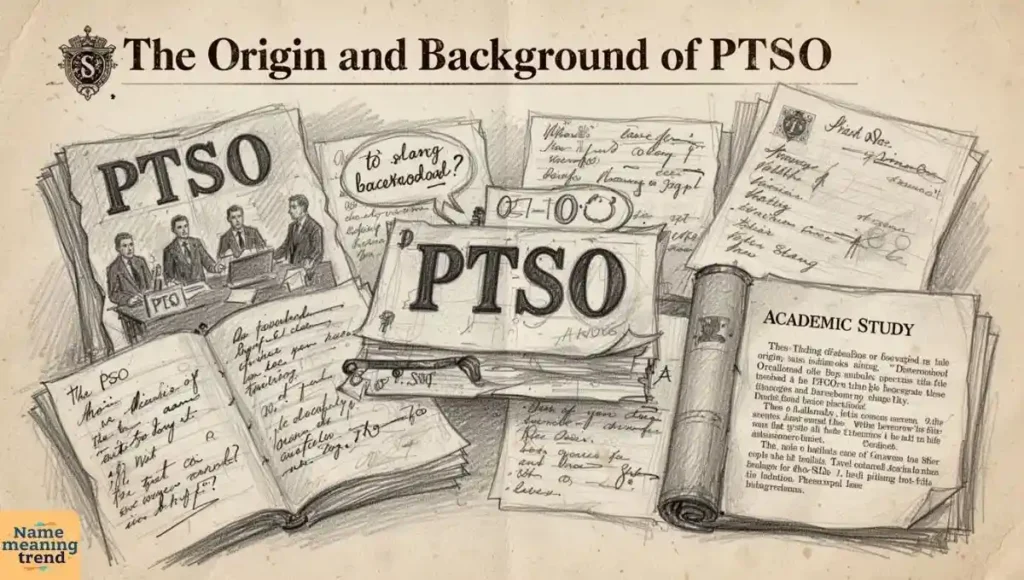
PTSO didn’t appear in any dictionary. It grew organically out of internet culture — the same culture that turned “I can’t even” into a complete sentence.
How It Started
PTSO is a spin-off of PTSD (Post-Traumatic Stress Disorder), which began appearing in memes and casual conversation around 2015–2018 as younger internet users started using clinical language in an exaggerated, non-literal way.
The pattern was simple: take a serious-sounding term, add humor, spread it across Twitter, Tumblr, and eventually TikTok. PTSO emerged as a variation that added “Obviously” — making the sarcasm even more explicit.
Its spread accelerated on platforms like:
- TikTok: (comment sections, reaction videos)
- Twitter/X: (meme tweets and replies)
- Discord: (gaming and community servers)
- Reddit: (especially in relatable humor threads)
Why It Became Popular
Three reasons drove PTSO into mainstream slang use:
- It’s short and punchy: easy to type mid-conversation
- It captures a feeling everyone knows: that lingering cringe or stress from a bad moment
- It fits meme culture perfectly: self-deprecating, dramatic, and instantly relatable
Gen Z communication tends to weaponize exaggeration for humor, and PTSO Meaning fits that style naturally.
PTSO vs PTSD – Important Difference
This distinction genuinely matters and is worth being clear about.
| Feature | PTSO | PTSD |
| Full Form | Post Traumatic Stress, Obviously | Post-Traumatic Stress Disorder |
| Type | Internet slang | Clinical mental health diagnosis |
| Tone | Humorous / Sarcastic | Serious |
| Medical? | No | Yes |
| Used by | Gen Z, online users | Mental health professionals, patients |
| Appropriate in serious talks? | No | Yes |
PTSO should never be used as a substitute for PTSD in any serious conversation. PTSD is a real, recognized mental health condition affecting millions of people. Using slang in those conversations minimizes real suffering.
If you’re discussing actual trauma, your own or someone else’s, always use accurate, respectful language.
Usage of PTSO in Different Contexts
PTSO pops up in a surprising range of online spaces. Here’s how the tone and intent shift depending on where you see it.
1. Casual Texting
This is the most natural home for PTSO. Among friends, it works as a quick emotional shorthand.
“Running into my ex at that party gave me full-blown PTSO. I need to move cities.”
The humor is obvious, the exaggeration is intentional, and nobody is confused.
2. Social Media & Memes
On platforms like Instagram and Twitter/X, PTSO often appears in captions or comment sections under relatable content.
Caption: “Accidentally liked a photo from 3 years ago. PTSO won’t let me sleep.”
Meme format pairs PTSO Meaning with dramatic imagery, crying emojis, or over-the-top reaction GIFs. Slang thrives in this environment.
3. Gaming Communities
Gamers use PTSO after brutal losses, difficult boss fights, or frustrating teammates. It’s practically a rite of passage.
“I’ve died at that checkpoint 20 times. Genuine PTSO. I’m going to bed.”
In Discord servers and Twitch chats, PTSO Meaning reads as camaraderie — a way of bonding over shared frustration.
4. Group Chats
In group chats with close friends, PTSO flows naturally as long as the group shares the same sense of humor.
Quick tip: If someone in the group has openly discussed real trauma or mental health struggles, skip the PTSO jokes. Read the room.
Read Also: 610+ Catchy and Cute Red Panda Names With Meanings
Is PTSO Offensive or Problematic?
This is where it gets nuanced. PTSO isn’t inherently offensive, but it can land badly depending on context and audience.
When It’s Usually Safe
- ✅ Among close friends who share the same humor
- ✅ In lighthearted meme captions
- ✅ When describing something universally cringe-worthy or stressful
- ✅ In gaming or fandom communities where this type of humor is the norm
When It Can Be Risky
- ❌ Around someone who has been open about real trauma or PTSD
- ❌ In conversations about mental health, abuse, or serious life events
- ❌ With people who don’t know the slang and might misread your tone
- ❌ In public posts that could reach a wide, unknown audience
Some people, particularly mental health advocates, feel that casually borrowing clinical terms for humor gradually desensitizes people to real conditions. It’s a fair concern, and worth keeping in mind even if your intent is totally innocent.
PTSO in Professional Communication
Short answer: Leave PTSO out of professional settings entirely.
Why It’s Not Appropriate
Internet slang in workplace communication creates three problems. First, it can come across as flippant or immature. Second, colleagues unfamiliar with the term may misinterpret it entirely, possibly thinking you’re referencing an actual mental health condition. Third, in industries like healthcare, education, or HR, misusing clinical-sounding language can raise real concerns.
Better Alternatives
| Instead of saying… | Try saying… |
| “That meeting gave me PTSO.” | “That meeting was genuinely overwhelming.” |
| “Client call PTSO activated.” | “I found that call really stressful.” |
| “PTSO from that deadline.” | “I’m still recovering from the pressure of that deadline.” |
Clear, professional language always communicates better, and more respectfully, than slang.
PTSO on TikTok & Internet Culture
TikTok played a significant role in spreading PTSO to a wider audience. The platform’s short-form format rewards punchy, expressive language, and PTSO fits that perfectly.
Common TikTok Usage
On TikTok, PTSO shows up most often in:
- Storytime videos where creators describe an embarrassing or stressful event
- Reaction content where the emotional overload is the punchline
- Comment sections on relatable videos about school, work, or social situations
Example comment: “This video brought back my 9th grade presentation PTSO. I had blocked that memory.”
The slang works so well on TikTok because the platform celebrates emotional expression, dramatic storytelling, and Gen Z humor, all things PTSO naturally fits into.
PTSO in Dating Apps & Online Chats
PTSO does appear in dating app conversations and direct messages, but it requires a bit more careful judgment.
Safe Usage
Using PTSO works fine when:
- You’ve already built some rapport and casual banter with the person
- The context is clearly lighthearted (talking about a funny date story, a cringe moment, etc.)
“My last blind date ended with me tripping over a chair in front of the whole restaurant. PTSO Meaning honestly 😅”
That reads as charming self-deprecation. Easy.
Risky Usage
Avoid PTSO when:
- You’re early in a conversation and don’t know the person’s communication style
- The topic is even slightly serious or emotionally sensitive
- The other person hasn’t used any slang themselves
When in doubt, spell it out. “That honestly stressed me out for weeks,” says the same thing and works for any audience.
How to Respond When Someone Says PTSO
Your response to PTSO should match the tone of the person using it. Here are some options:
Casual Responses
- “Honestly, same. 😭”
- “PTSO unlocked, respect.”
- “That track. I’d need recovery time too.”
Funny Responses
- “Certified traumatic moment. We need to debrief.”
- “PTSO squad, welcome.”
- “Did it at least leave you a good story?”
Supportive Responses
- “That sounds genuinely rough. Are you doing okay?”
- “Oof. That would stress anyone out.”
Professional Responses
If PTSO somehow appears in a work message and you need to respond professionally, just ignore the slang and address the underlying point:
- “That sounds like it was a stressful experience. Let me know if there’s anything I can help with.”
610+ Good Feet Finder Names: A Compelling List for Every Style
Similar Slang Terms to PTSO
PTSO belongs to a broader family of internet slang that borrows emotional or clinical-sounding language for dramatic effect.
| Slang Term | Meaning | Tone | Risk Level |
| PTSO | Post Traumatic Stress, Obviously | Sarcastic / Humorous | Medium |
| “Triggered” (slang) | Strong emotional reaction | Casual / Sometimes edgy | Medium–High |
| “I’m scarred” | Embarrassed or put off | Light | Low |
| “Traumatized” (slang) | Exaggerated reaction to something bad | Informal | Medium |
| “Unalived” | Death (used to dodge content filters) | Very risky | High |
| “Brainrot” | Obsessive or nonsensical thinking | Gen Z humor | Low |
PTSO is on the safer end of this spectrum, it’s not targeting anyone, it’s self-directed humor. But like all terms in this category, context is everything.
Regional & Cultural Differences
United States
PTSO is most commonly understood in the US, where it originated in Gen Z internet culture. American social media users, especially on TikTok and Twitter/X, are most likely to recognize it immediately.
UK & Canada
In the UK and Canada, PTSO exists but is less widespread. Some users will get it right away; others, especially outside Gen Z, may not recognize it at all. It’s safer to use with younger, socially online audiences in these regions.
Non-Native English Speakers
For non-native English speakers, PTSO is often confusing precisely because it looks and sounds like PTSD. Many learners are familiar with PTSD as a serious medical term, so encountering PTSO Meaning without context can cause genuine misunderstanding. If you’re communicating across language backgrounds, avoid the abbreviation entirely and use plain language instead.
Common Situations Where People Use PTSO
Here are the real-world moments that typically trigger the use of PTSO in conversation:
- 📚 Academic stress: failed exams, brutal assignments, public presentations
- 😬 Social cringe: embarrassing moments in public or on dates
- 🎮 Gaming frustration: losing streaks, difficult levels, toxic lobbies
- 💼 Work stress: overwhelming meetings, difficult clients, missed deadlines
- 💔 Relationship awkwardness: running into an ex, a bad breakup, ghosting
- 📱 Social media regret: finding old posts, accidental likes, cringeworthy throwbacks
The common thread: something happened that was stressful or embarrassing enough to stick with you, even if only briefly. That lingering feeling is what PTSO captures.
Read Also: 350+ Magical Harry Potter Trivia Team Names for Every Quiz Night
Common Misunderstandings About PTSO
A few misconceptions about PTSO are worth addressing directly:
❌ “PTSO is just another way to say PTSD.” No. PTSO is slang; PTSD is a clinical diagnosis. They are not interchangeable under any circumstances.
❌ “If someone says PTSO, they’re telling me something serious.” Almost never. The slang is designed for humorous, exaggerated use. If someone is experiencing actual distress, they typically won’t reach for internet abbreviations.
❌ “PTSO is new slang nobody knows yet.”It’s been circulating in online communities since the mid-to-late 2010s. While not universal, it’s well-recognized in Gen Z spaces and social media culture.
❌ “Using PTSO is always harmless.” Context matters. In the wrong setting or around the wrong audience, it can minimize real experiences and come across as insensitive.
FAQs About PTSO Meaning Slang
What does PTSO meaning in slang?
PTSO meaning stands for “Post Traumatic Stress, Obviously.” It’s internet slang used to humorously describe an exaggerated emotional reaction to something stressful or embarrassing.
What does PTSO mean in texting?
In text messages, PTSO means someone is jokingly saying an experience stressed them out or left a lasting cringe impression; it’s not a serious or medical statement.
Is PTSO the same as PTSD?
No. PTSD is a real clinical mental health condition. PTSO is casual internet slang and should never be used as a substitute for PTSD in serious conversations.
Where did PTSO slang come from?
PTSO evolved from internet meme culture, inspired by the clinical term PTSD. It spread through TikTok, Twitter, and Discord around the mid-to-late 2010s as Gen Z began using exaggerated emotional language online.
Is PTSO offensive?
It can be, depending on context. Around people with real trauma or in serious mental health discussions, using PTSO Meaning is insensitive. Among friends in lighthearted settings, it’s generally fine.
What does PTSO mean on TikTok?
On TikTok, PTSO appears in comment sections and captions to dramatize a stressful memory or embarrassing moment, usually paired with humor, crying emojis, or a relatable story.
Should I use PTSO at work?
No. PTSO is informal internet slang and is inappropriate in professional communication. Use clear, respectful language instead.
Can PTSO be used in a supportive way?
Not really, it’s designed for humor and exaggeration, not genuine emotional support. If someone is expressing real distress, respond with empathy rather than slang.
Conclusion
The meaning of PTSO Meaning Slang is not always the same, which is why many people search for it online. In casual conversations, it may be used as internet shorthand, while in educational settings it commonly refers to a Parent Teacher Student Organization. The correct interpretation depends on the platform, conversation, and the speaker’s intent.
As online language continues to evolve, new slang terms and acronyms appear regularly, making context more important than ever. Knowing the different uses helps you avoid confusion and communicate more effectively. With this guide, PTSO Meaning Slang becomes easier to recognize, allowing you to understand messages accurately and respond with confidence in any situation.

Welcome to Namemeaningtrend! I’m Abdul Mannan, your AI-powered SEO wordsmith, turning humor, creativity, and 7 years of experience as a content writer into digital magic. I craft viral Names and NamesMeaning lines that make every post shine.